DUBAI, June 24 —
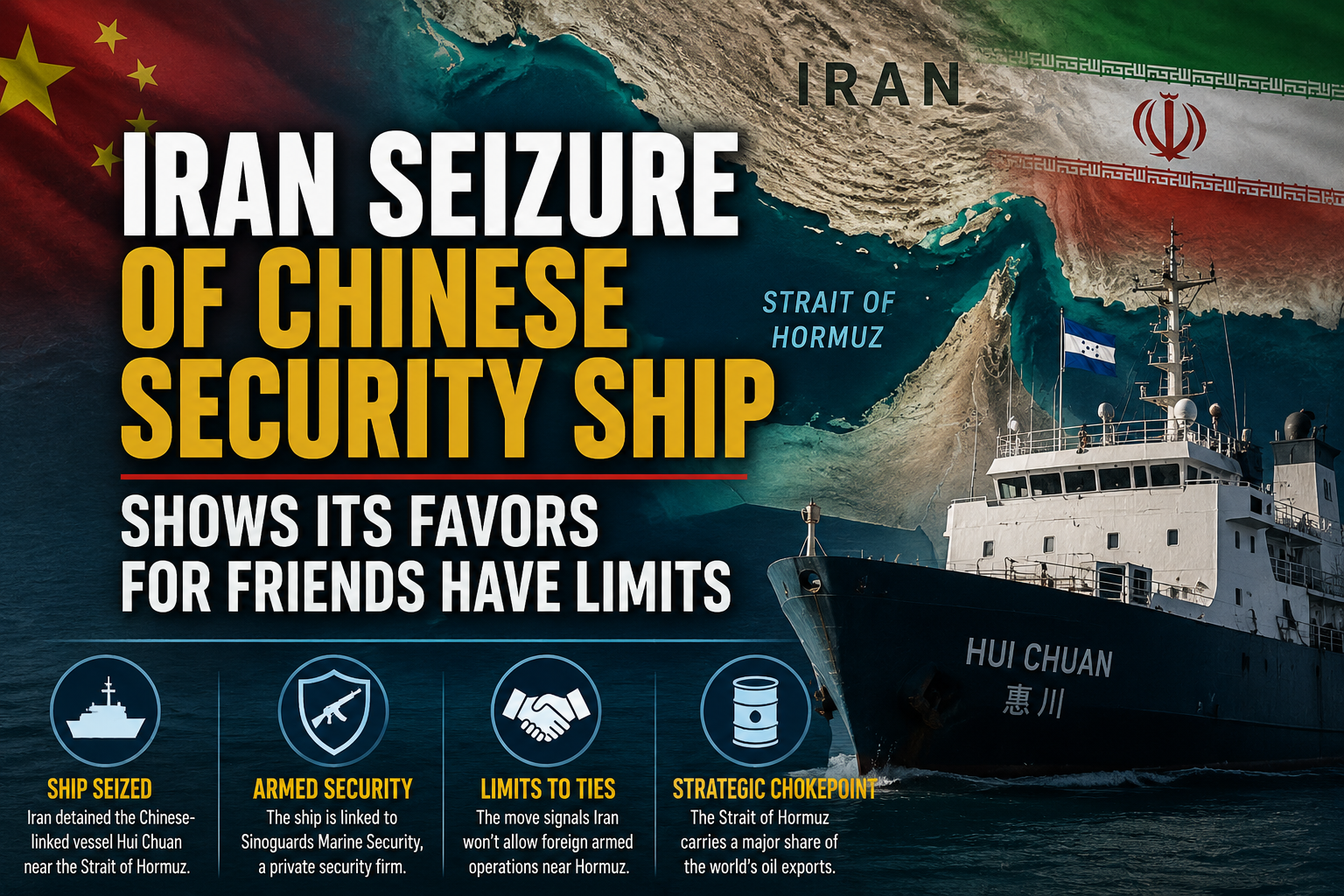
- Ship Seized: Iran detained the Hui Chuan, a support vessel linked to Chinese maritime security firm Sinoguards Marine Security.
- Location: The vessel was anchored about 38 nautical miles northeast of Fujairah, UAE, near the Strait of Hormuz.
- Timing: The seizure occurred the same day President Donald Trump met Chinese President Xi Jinping in Beijing.
- Strategic Signal: Analysts say Iran may be signaling that foreign private armed security operations will not be tolerated near Hormuz.
- Chinese Role: A Chinese tanker reportedly transited Hormuz earlier under an arrangement permitting select commercial traffic.
- Security Concerns: Sinoguards is known for supplying armed guards for shipping routes in Asia and Africa.
| Metric | Value | Context |
|---|---|---|
| Distance from Fujairah | 38 nautical miles | Location where vessel was anchored |
| Security firm founded | 2013 | Year Sinoguards Marine Security was established |
| Key maritime chokepoint | Strait of Hormuz | Major route for global oil exports |
| Vessel flag | Honduras | Registration of Hui Chuan |
| Previous armed incident | 2024 | Sinoguards-linked vessel reportedly repelled Houthi attack |
Iran Detains Chinese-Linked Security Vessel
Iran has seized a vessel owned by Sinoguards Marine Security, a Hong Kong-registered company that provides armed maritime protection, in a move analysts say underscores Tehran’s insistence on maintaining control over security around the Strait of Hormuz.
The vessel, Hui Chuan, was reportedly detained after Iranian authorities requested compliance documentation before escorting the ship into Iranian waters. The company described the move as part of an inspection process.
Sensitive Timing Amid Diplomatic Pressure
The incident occurred during a period of heightened regional tensions and coincided with talks between President Donald Trump and Chinese leader Xi Jinping in Beijing, where discussions reportedly included Iran and maritime stability.
The seizure followed reports that Iran had permitted at least one Chinese commercial tanker to pass through the strait, suggesting Tehran may be distinguishing between trade access and foreign-backed maritime security operations.
Why the Strait of Hormuz Matters
The Strait of Hormuz remains one of the world’s most important oil chokepoints, carrying a major share of global crude exports. Any disruption or military escalation in the region can quickly affect energy prices and shipping costs.
Security companies operating near Gulf ports often maintain offshore storage for weapons because many regional ports restrict armed equipment on land. Sinoguards has marketed armed escort services for vessels operating through the Gulf of Oman and nearby waters.
China’s Security Footprint Abroad
Industry analysts say China has increasingly relied on private security companies to safeguard overseas commercial interests, especially after piracy risks expanded in the early 2010s.
Unlike Western military contractors or Russia-linked paramilitary groups, Chinese firms generally operate under tighter oversight and avoid direct alignment with military operations abroad. Analysts say Beijing remains cautious about allowing private armed activity outside state control.
While Chinese officials have not publicly escalated the issue, observers say the detention illustrates that Iran’s cooperation with Beijing may have limits when national security concerns are involved.