CHARLOTTESVILLE, Va. —
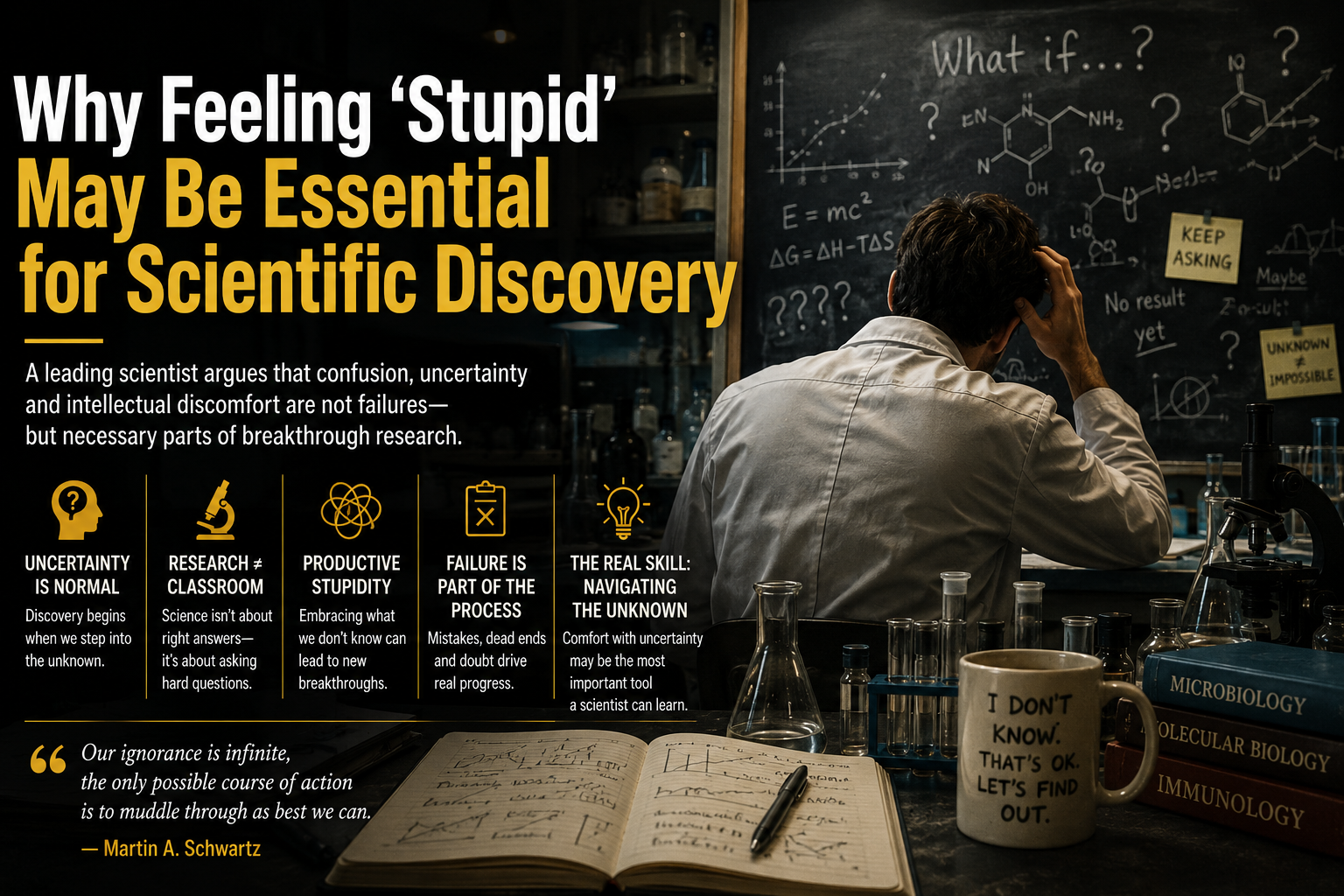
- Core argument: Scientist Martin A. Schwartz says feeling “stupid” is an unavoidable part of meaningful scientific research.
- Research challenge: Scientific discovery often requires working in areas where answers are unknown and outcomes uncertain.
- Education gap: Schwartz argues academic systems may not prepare students for the emotional demands of research.
- “Productive stupidity”: The essay introduces the idea that intellectual discomfort can lead to deeper learning and innovation.
- Main takeaway: Progress in science depends not on knowing answers, but on learning how to navigate uncertainty.
A Different View of Intelligence in Science
Scientific success is often associated with intelligence, expertise, and confidence. But according to microbiologist Martin A. Schwartz, one overlooked ingredient may be just as important: the willingness to feel “stupid.”
In his widely discussed essay, “The Importance of Stupidity in Scientific Research,” Schwartz argues that real scientific progress happens when researchers move beyond familiar knowledge into questions with no clear answers.
Rather than seeing confusion as failure, Schwartz describes it as a natural part of discovery. He suggests scientists frequently operate in situations where they do not know whether they are asking the right questions, using the right methods, or moving toward the right conclusions.
Why Research Feels Different From School
Schwartz contrasts scientific research with traditional education, where success often comes from mastering known material and giving correct answers.
In classrooms, students are rewarded for certainty and accuracy. Research, however, requires entering unfamiliar territory where answers may not exist and mistakes are common.
The essay recounts Schwartz’s own experience during graduate school, when he struggled with a difficult problem and discovered that even leading experts lacked clear solutions. That realization, he wrote, changed his understanding of science — showing him that uncertainty was not weakness, but part of the process.
The Case for ‘Productive Stupidity’
A central idea in the essay is what Schwartz calls “productive stupidity” — the deliberate acceptance of ignorance while tackling difficult questions.
He argues that important discoveries often emerge only after repeated failures, confusion, and experimentation. In this view, discomfort becomes a sign that researchers are pushing boundaries rather than repeating known answers.
Schwartz also criticizes graduate education for not fully preparing students for this reality, saying many researchers struggle emotionally when faced with prolonged uncertainty.
A Lesson Beyond Science
Although written for researchers, the essay has resonated more broadly among students, educators, and professionals navigating complex problems.
Its message is simple but challenging: meaningful progress often begins when people admit what they do not know and continue searching anyway.
For Schwartz, becoming comfortable with uncertainty may be one of the most valuable skills a scientist — or anyone solving difficult problems — can develop.


