OAKLAND, California, May 18 —
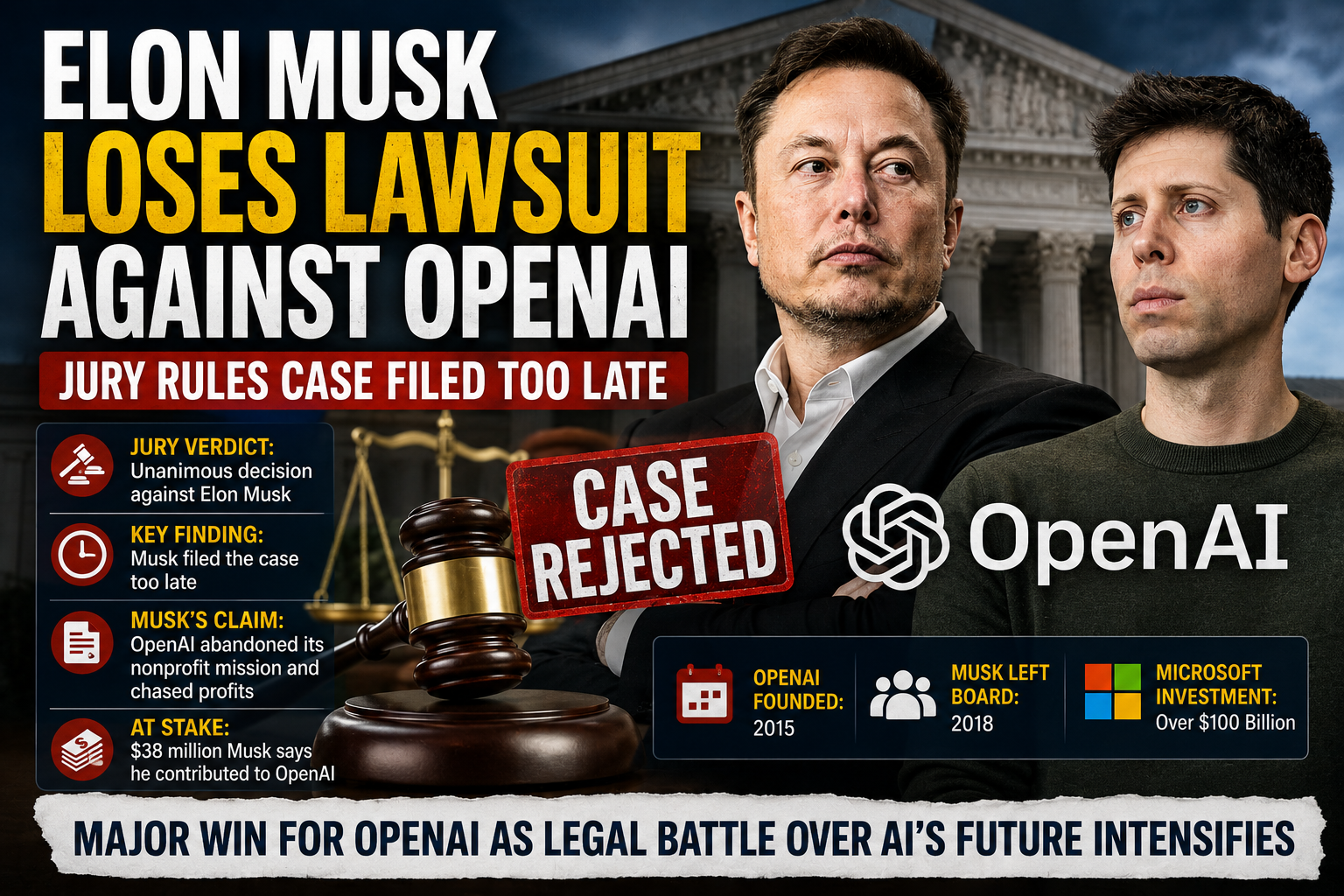
- Jury Verdict: A federal jury ruled against Elon Musk in his lawsuit against OpenAI.
- Core Finding: Jurors found Musk filed the case too late, siding with OpenAI on statute-of-limitations grounds.
- Claims Rejected: Musk alleged OpenAI abandoned its nonprofit mission and improperly shifted toward profit-making.
- Money at Stake: Musk claimed he contributed roughly $38 million to OpenAI before leaving in 2018.
- Microsoft Ties: OpenAI later accepted tens of billions of dollars in backing, including major support from Microsoft.
- Appeal Possible: Musk’s legal team said it may pursue an appeal.
| Metric | Value | Context |
|---|---|---|
| Jury deliberation time | Under 2 hours | Verdict reached quickly |
| Musk contribution claim | $38 million | Funding allegedly provided to OpenAI |
| OpenAI founded | 2015 | Company launch year |
| Musk departure | 2018 | Left OpenAI board |
| Microsoft investment | Over $100 billion | OpenAI partnership spending |
| Potential OpenAI valuation | $1 trillion | Possible IPO target |
Jury Rejects Musk’s Case Against OpenAI
A U.S. jury ruled against Elon Musk in his lawsuit accusing OpenAI of betraying its original mission to develop artificial intelligence for the benefit of humanity rather than profit.
Jurors in federal court in Oakland, California, concluded that Musk brought the case too late, delivering a unanimous verdict after less than two hours of deliberation.
The lawsuit had been closely watched across the technology industry because of its implications for AI governance, nonprofit structures, and investor influence.
Musk Claimed OpenAI Shifted Its Mission
In the lawsuit filed in 2024, Musk accused OpenAI CEO Sam Altman, company president Greg Brockman, and the organization itself of misleading him into supporting a nonprofit venture before later attaching a for-profit business model.
Musk argued the company abandoned its founding principles by accepting major outside investment and prioritizing commercial growth over public benefit.
OpenAI was founded in 2015 by Musk, Altman, and other technology leaders. Musk departed the board in 2018, and the organization established a for-profit arm the following year.
Credibility Battle Dominates Trial
The case featured repeated challenges to the credibility of both Musk and Altman during nearly two weeks of testimony.
Musk’s legal team argued OpenAI executives prioritized financial gain, while OpenAI countered that Musk himself had commercial ambitions and waited too long to pursue legal action.
Judge Yvonne Gonzalez Rogers suggested after the ruling that overturning the verdict could be difficult because the timing question was heavily supported by trial evidence.
High Stakes for AI Industry
The verdict arrives as OpenAI expands rapidly and explores a potential public offering that could reportedly value the company at around $1 trillion.
The company faces growing competition from rivals including Anthropic and Musk’s own AI venture, xAI, while continuing to deepen ties with Microsoft, which has invested more than $100 billion into the partnership.