WASHINGTON, June 24 —
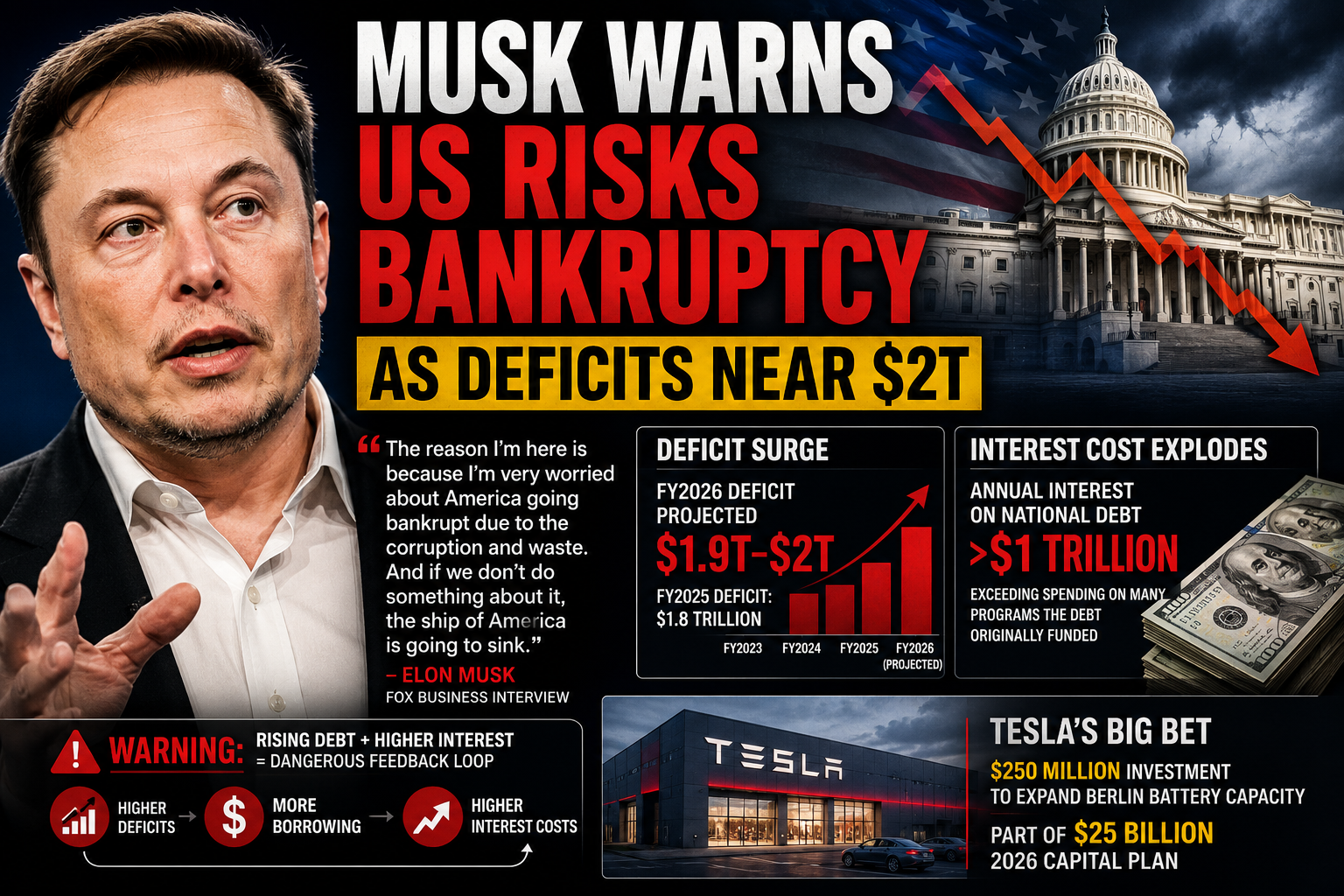
- Musk Warning: Elon Musk said America risks “bankruptcy” if corruption, waste, and overspending are not addressed.
- Deficit Outlook: U.S. fiscal deficits are projected to approach $1.9–$2 trillion in FY2026.
- Interest Burden: Annual interest payments on the national debt have exceeded $1 trillion.
- Debt Cycle Risk: Economists warn rising borrowing costs could create a self-reinforcing debt spiral.
- Tesla Investment: Tesla plans to invest $250 million to expand battery capacity in Berlin as part of a broader $25 billion capital spending plan for 2026.
| Metric | Value | Context |
|---|---|---|
| FY2025 deficit | $1.8 trillion | Estimated federal budget gap |
| FY2026 projected deficit | $1.9–$2 trillion | Forecast range |
| Annual debt interest cost | Over $1 trillion | Federal interest payments |
| Tesla Berlin investment | $250 million | Battery capacity expansion |
| Tesla 2026 capex plan | $25 billion | Company-wide investment target |
Musk Sounds Alarm on US Fiscal Path
Tesla CEO Elon Musk warned that the United States risks financial collapse if rising government deficits and spending inefficiencies are left unchecked.
In a widely circulated interview, Musk compared the nation’s fiscal trajectory to an individual going bankrupt, arguing that unchecked borrowing and waste threaten long-term stability.
“The ship of America is going to sink,” Musk said, describing growing debt levels as unsustainable if policymakers fail to control spending.
Deficits and Interest Costs Climb
Federal fiscal data show the U.S. closed FY2025 with an estimated deficit of roughly $1.8 trillion, while projections for FY2026 suggest borrowing could approach $2 trillion.
Annual interest payments on the national debt have now exceeded $1 trillion, increasing pressure on government finances and limiting room for future policy spending.
Economists caution that higher deficits combined with rising interest rates can create a feedback loop in which larger debt loads generate even higher financing costs.
Critics Challenge Musk’s Analogy
Some economists argue Musk’s comparison between national finances and household bankruptcy oversimplifies how sovereign debt works.
Unlike households, the U.S. government issues debt in its own currency and retains broader fiscal and monetary flexibility. Still, analysts broadly agree that rapidly rising debt servicing costs pose long-term risks to growth and fiscal planning.
Tesla Expands Despite Macro Concerns
Separately, Tesla plans to invest $250 million to increase battery production capacity in Berlin, part of a larger $25 billion capital expenditure strategy planned for 2026.
The expansion reflects Tesla’s continued push into manufacturing even as investors monitor cash flow and broader economic conditions.